
Creativity and Reflexivity
This group is led by;
Stephanie Smith (she/her)
RN BSc Hons, FHEA, Masters Med Ed
Senior CRCS Tutor (Clinical Reasoning Communication Skills)
Clinical Reasoning Communication Skills (CRCS formerly CCS), University of Cambridge
This sub-group of education researchers meets to discuss research in creativity and reflexivity.
Reflective writing is an important tool in developing clinical practice. I developed an interest in reflexivity as a tutor supporting medical students who have struggled with reflective writing. As a student myself, on the Masters in Medical Education pathway, I began questioning, how an ‘art-based task’ influenced my reflective processes. This curiosity in reflexivity and creativity developed through discussions with colleagues and we decided to explore the literature and do some research. I want to get a community together on reflexivity and creativity to share ideas, experiences, and support researchers in this fascinating area of education. Get in touch and join our community.
Exhibition of work by medical students using creativity for reflection on clinical experiences
Pre-clinical course, Preparing for Patients module C
1. Title: An exploding star by Chloe Jacob (2025)
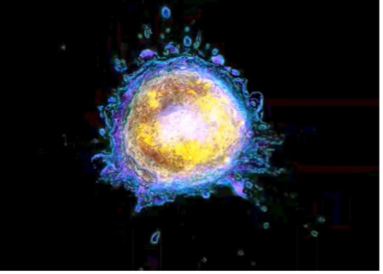
During my visit to the Cambridge Cancer Help Centre (CCHC), I met such extraordinary people whose honesty, and warmth left a long-lasting impression on me. Those that I met came from all walks of life, carrying their unique experiences, fears, and memories. Yet, despite the weight of living with cancer, what struck me most was not a sense of sadness, but a real sense of hope. Hope for their treatment, futures and their community.
This piece grew out of that feeling. I chose to work with Touch Designer, a digital modelling software, to create dynamic particle compositions. Using adapted material from Nanolive’s cell analysis, the video shows a cancer cell undergoing apoptosis accompanied by a melody. From this, I hope to show that each cancer cell that dies becomes a moment where life can continue.
This project is a thank you to the people at the centre, and the CCHC's incredible work. They taught me that hope and gratitude are the strongest things one can have, and as a future doctor, I hope to carry that lesson with me. To remember that even in moments of loss or uncertainty, one ending is an inevitable beginning.
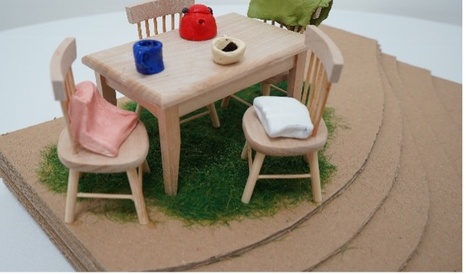
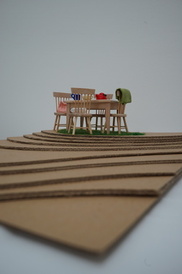
2. Title: A place to breathe, above the plain by Disha Mondal (2025)
My creative work began after visiting Maggie’s Cancer Centre in Cambridge. During the visit, I learned how the centre was created to feel different from a hospital and how its design aims to give people a sense of calm and dignity. The idea of “kitchenism” which is the belief that a kitchen table can act as a place for conversation, grounding, and comfort, stood out to me. I also read The Architecture of Hope by Charles Jencks, which explained how the buildings were shaped by Maggie’s philosophy. This combination of the visit and the book gave me a clear emotional point that I wanted to express through art.
The visit had a strong effect on me because it showed the difference that thoughtful design and small human details can make during a difficult time. I chose this topic because the contrast between the hospital environment and the atmosphere inside Maggie’s felt meaningful. The centre showed how a welcoming space can ease fear, reduce isolation, and bring people together. This idea stayed with me, and I wanted my work to show how hope can stand out even when everything else feels heavy or uncertain.
The work is titled “A place to breathe, above the plain.” I used cardboard to build a layered topographic hill and placed a kitchen table at the top with colourful clay mugs and a teapot. The kitchen table, made with simple materials, represents comfort and hope. The bright clay objects show warmth and community in contrast to the plain landscape below.
Through this project, I learned how much space and design can influence emotional well-being. I also realised that support does not only come from medical treatment but from environments that encourage conversation, rest, and dignity. Thinking about Maggie’s philosophy helped me understand the importance of creating places that feel human and supportive. The process made me reflect on how hope can appear in small, ordinary things, and how these moments can help people face difficult experiences.
(This model can viewed in the Deakin Centre, level 2)
3. Title: Reach Out by Hannah Xing (2025)
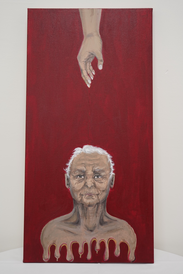
I used acrylic on a 30x70 canvas. My works often features bright, red backgrounds which represents inner struggles, life, death and change. While jarring, it attracts the viewer’s attention to the focus of the painting; the elderly person dripping away, the hand and the almost imperceptible line that connects them.
This piece represents the patients I spoke to, who experienced a range of different neurological conditions from subarachnoid haemorrhage to stroke, meningitis and more. They talked about the sudden changes in their life, to their work and social circles, and the isolation and confusion due to lack of information about what life would be like after. The phrases ‘forgotten’, ‘left behind’ and ‘dumped’ were often repeated in our meetings. However, their resilience and determination to continue living was inspirational, and they showed me the importance of how support from even a single person could make a significant difference.
The experiences I had on my placement were by no means unique. Hearing criticism for the NHS has become widespread on the internet nowadays, with budget, waiting times and fair wages being hotly debated across social media platforms. However, as a medical student, the struggling NHS seemed like a faraway entity and the complaints mellow in comparison to what I perceived were worse threats, such as exams. Hearing real people speak on their own experiences of the NHS was a significant wakeup call that gave me insight into the challenges our systems face.
As a future doctor, these conversations will remind me to always maintain clear communication, and to try my best to reach out. Individually, it seems impossible to change the behemoth institution that is the NHS, but I hope that my painting will remind those that see it of the importance of our role and our responsibilities to always make changes for the better.
(This painting can be viewed in the Deakin Centre, level 2)